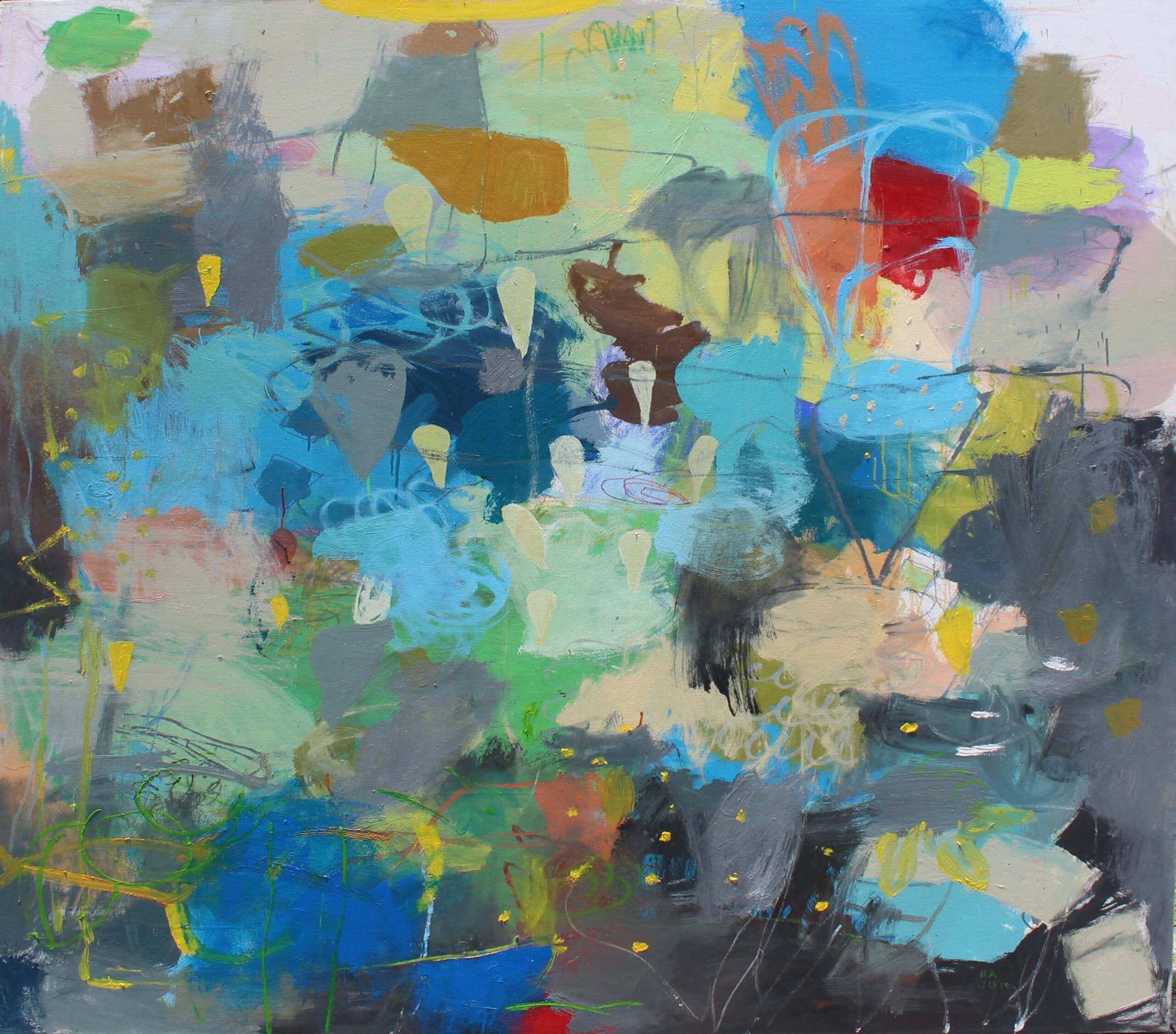
The most compelling emerging Latin American artists to collect in 2026 are working outside the traditional Mexico City–São Paulo axis, in Guatemala, Panama, Oaxaca and Venezuela. At Aura Galerías we currently represent a group of them directly: Alberto Ramírez (Mexico), Josué Romero (Guatemala), Gennaro Rodríguez (Panama), Lucía Bueso (Guatemala), Miguel Cuauhtémoc (Mexico) and Alejandro Brito (Venezuela). Their work spans gestural abstraction, geometric abstraction, figurative painting and hyperrealism, and — unlike blue-chip Latin American names — it is still available at primary-market prices, directly from the gallery, with international shipping to the United States.
This guide is written for collectors outside Latin America who want to buy early with real information: who these artists are, what they make, what their exhibition record actually looks like, and how acquisition works from abroad.
What “emerging” actually means in the Latin American market
The word gets used loosely. In the Latin American context, an emerging artist is generally one who meets most of these conditions:
- Primary market only. Their work has not yet established a consistent auction record, so pricing comes from the gallery rather than from secondary-market comparables.
- A building, verifiable exhibition record. Group shows, regional biennials, and institutional or corporate collections — not yet major museum retrospectives.
- An identifiable body of work. A recognizable language, not a portfolio still searching for direction.
- Accessible entry pricing. Typically a fraction of what mid-career work by the same nationality commands.
Note what is not on that list: age. Several of the strongest emerging Latin American artists came to painting after a full first career — in architecture, in design, in the corporate world. That late arrival often produces a more resolved body of work, not a less resolved one.
The second thing worth understanding is geographic. Global attention to Latin American art concentrates on Mexico City and São Paulo, which means Central America and the Caribbean are consistently underpriced relative to the quality of what is being made there. Guatemala in particular — with the Bienal de Arte Paiz and the Juannio auction as anchors — has an art infrastructure that most international collectors have never encountered.
Six emerging Latin American artists to know in 2026
| Artist | Origin | Medium & style | Key credential |
|---|---|---|---|
| Alberto Ramírez | Mexico City, 1978 | Oil and mixed media; gestural abstraction | ENAP graduate; Talento Joven, Mexico City government, 2007 |
| Josué Romero | La Antigua Guatemala, 1974 | Painting; contemporary figuration | Imago Mundi collection, Fondazione Benetton (Italy); Bienal de Arte Paiz |
| Gennaro Rodríguez | Panama | Acrylic and aerosol; geometric abstraction | Trained architect, Universidad Santa María la Antigua |
| Lucía Bueso | Guatemala | Painting; intuitive colour abstraction | Studio practice since 2019; training at ARIE and ArtXcelerate |
| Miguel Cuauhtémoc | Mexico | Painting and drawing; expressionist figuration | Escuela de Diseño, INBA |
| Alejandro Brito | Caracas, Venezuela, 1984 | Oil, acrylic, airbrush; hyperrealism and photorealism | School of Realism, South Carolina, under Dru Blair |
Alberto Ramírez — abstraction in the Mexican colour tradition
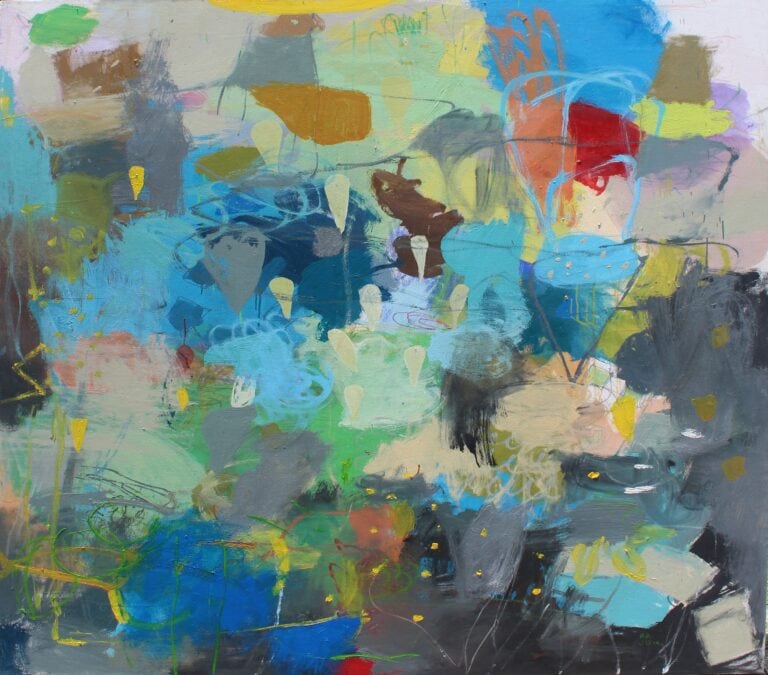
Born in Milpa Alta, Mexico City, in 1978, Alberto Ramírez graduated in Visual Arts from the Escuela Nacional de Artes Plásticas (ENAP). His abstraction treats colour as material and gesture as structure — a sensibility that sits recognizably downstream of Rufino Tamayo and Francisco Toledo, particularly in its chromatic handling and the tactile richness of the surfaces.
Ramírez’s career runs in parallel across three tracks: painting, cultural management, and teaching. He coordinated the Museo Regional de Milpa Alta and now teaches experimental drawing and abstract painting at the Museo Universitario de Ciencias y Artes (MUCA). In 2007 he was selected for the Mexico City government’s Talento Joven programme. He lives and works in Mexico City.
Why collect now: the institutional teaching position and the ENAP lineage give his work a credential base that most self-taught emerging painters lack, while pricing remains firmly primary-market.
Josué Romero — Guatemalan figuration with an international collection record
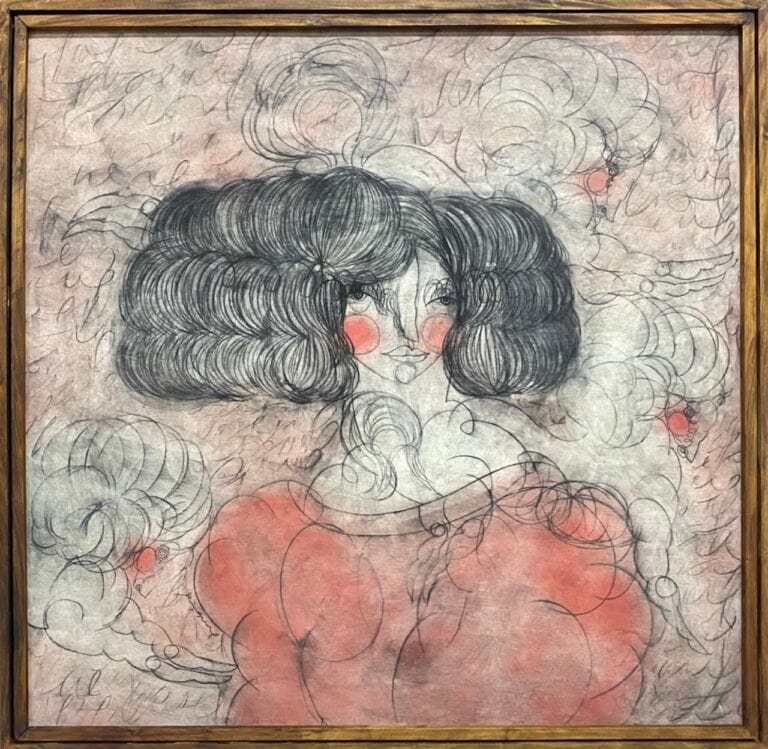
Of the artists on this list, Josué Romero has the most substantial institutional record. Born in La Antigua Guatemala in 1974, he studied Architecture at the Universidad de San Carlos de Guatemala before turning to painting, which he pursued self-taught.
He has shown at the most significant platforms in Central American art: the Bienal de Arte Paiz, the Bienal de Artes Visuales del Istmo Centroamericano (BAVIC), and the Juannio Latin American art auction. His work is held in the Imago Mundi collection of the Fondazione Luciano Benetton in Italy. He took first prize in Guatemala’s Helvetas competition (2004) and second in the Concurso Joven Pintor (2001), and has worked in the public realm with murals including El Bestiario on the exterior wall of the La Aurora Zoo.
Why collect now: a European institutional collection placement plus a biennial record is unusual at this price level. This is the profile that typically re-rates first.
Gennaro Rodríguez — an architect’s geometry, a painter’s colour
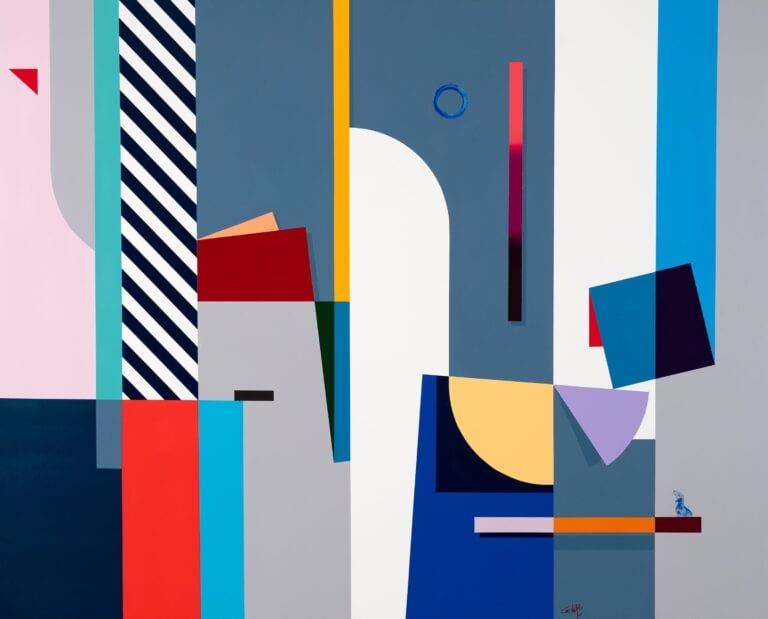
Gennaro Rodríguez trained as an architect at the Universidad Santa María la Antigua in Panama, and it shows: his compositions are built on rigorous geometric structure, then flooded with colour applied in acrylic and aerosol. The result is a set of refined symmetries and complex tonalities — volume and light constructed rather than described.
He has described his turn to painting as beginning with the shock of encountering the colour in a work by the French artist Françoise Nielly, and wanting to produce that same sensation in others. Panama is a genuinely under-collected market internationally, which makes his work one of the more asymmetric propositions on this list.
Lucía Bueso — colour as emotional vehicle
Lucía Bueso is a Guatemalan abstract painter whose practice began formally in 2019, the year her first child was born — painting having first served as a refuge during the demands of early motherhood. Essentially self-taught, she has supplemented her practice with formal training in Abstract Art at ARIE, Color Theory at Lemonbe, and the ArtXcelerate programme at D’Agency.
Her work is characterized by an intuitive palette and compositions where gesture and material build atmospheres aimed at an emotional rather than descriptive response. It is the earliest-stage practice on this list and priced accordingly.
Miguel Cuauhtémoc — a formal training, deliberately broken
Miguel Cuauhtémoc describes his own formation in three steps: love the art, study it, then break the rules. He took a degree in Design at the Escuela de Diseño of the INBA in Mexico City, and cites a wide set of influences — the poet Efraín Huerta, Henri Cartier-Bresson, Max Beckmann, Emil Nolde, Alberto Giacometti, Herbert Bayer — that place him more in a European expressionist lineage than a strictly Mexican one.
Alejandro Brito — Venezuelan hyperrealism
Alejandro Brito (Caracas, 1984) is the technical outlier here. He won “Best Applied Technique” in Venezuela’s Afiches Simón Rodríguez competition at sixteen, spent more than a decade in the corporate world while painting at night, then committed to the studio full time.
He studied hyperrealist figurative drawing and oil painting for six years at the Museo Tesari-Rizzo under Patrizia Rizzo, then travelled to South Carolina to study at the School of Realism under Dru Blair, where he trained in basic and advanced airbrush technique. Collectors who want photorealism rather than abstraction should start here. Availability is currently the most limited on this list.
Beyond emerging: the mid-career Latin American artists most collectors buy
An honest note. Emerging work is where discovery happens, but most of our international collectors ultimately buy mid-career — artists with a thirty-year record, deeper available inventory, and a price already tested by the market. If you are building a collection rather than speculating, these are the names to weigh alongside the list above.
- Carlos Vivar (Mexico City, 1964) — vibrant figurative painting. Studied graphic design in Mexico City and took a master’s in graphic arts in Milan; first solo show 1994. The deepest available body of work in our catalogue.
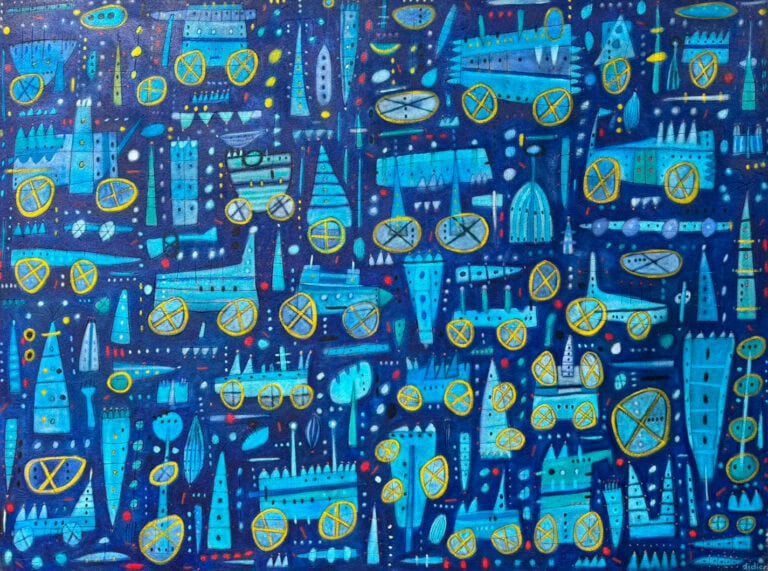
- Didier Mayés (Oaxaca, 1968) — playful minimalist abstraction of point, line and colour, plus the Big Heads figures. Trained at Oaxaca’s Escuela de Bellas Artes and in industrial design at UAM Xochimilco.
- Jorge Vidals (Oaxaca de Juárez, 1984) — encaustic, oil, watercolour; solo exhibitions including Pueblos Mágicos (Aura Galerías, Guatemala City, 2022) and a group show in New York (2017).
- Alan Benchoam (Guatemala, 1970) — photographic collages built from an archive of more than 3,000 photographs of doors from nine countries. His most ambitious work is a human portrait composed of 1,087 individually photographed doors.
- René Martín (Havana, 1960; based in Mexico since 1995) — “tropical surrealism”: floating jungles, forks that become palm trees, drifting eggs. Trained at San Alejandro in Havana.
- Miki (Mexico City, 1956) — self-taught sculptor, 55+ solo exhibitions, currently shown in Singapore, Miami, New York, Dubai, Madrid, Paris, London and Monaco.
How collectors in the United States acquire from Mexico
Buying from a Mexican gallery as a US collector is more straightforward than most people expect. The practical sequence:
- Enquire on a specific work. Contact us with the artist and title. We confirm availability, current price in MXN or USD, dimensions, medium and year, and send additional photography and a condition note.
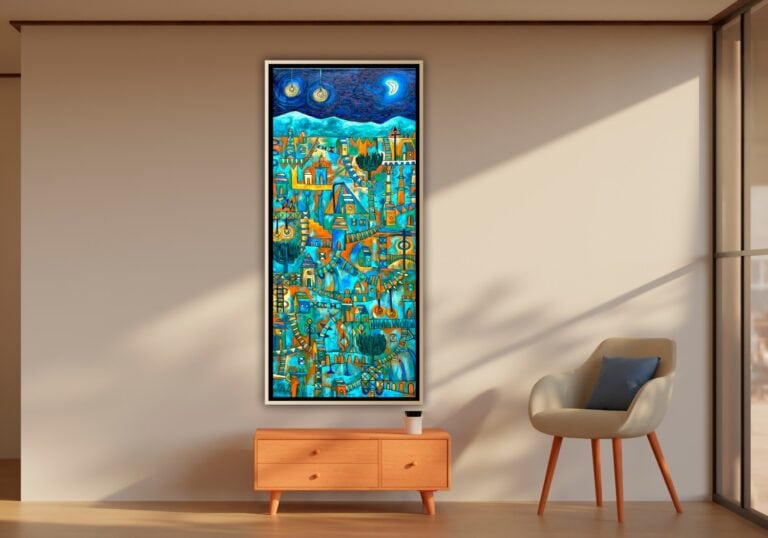
- Request a virtual viewing. We run virtual displays — the work shown to scale in your own room — which resolves most sizing decisions remotely.
- Confirm and pay. Wire transfer in MXN or USD. Price is quoted before any shipping or framing is added.
- Packing and shipping. Professional packing and international shipping are handled in-house. See shipping and returns.
- Framing, if wanted. Framing and museography are available before the work leaves Mexico, which is generally cheaper than framing on arrival in the US.
Original works of art enter the United States under HTS heading 9701 and are generally duty-free, though customs treatment depends on the specific work and on current trade rules — we recommend confirming with your own customs broker. Our services also include appraisals and art and tax consulting for collectors structuring a collection.
Aura Galerías operates from Mexico City, with a catalogue that also covers Guatemala. If you are travelling, the Lomas gallery can be visited by appointment.
Frequently asked questions
Who are the top emerging Latin American artists to collect in 2026?
Among artists represented by Aura Galerías: Alberto Ramírez (Mexico, gestural abstraction), Josué Romero (Guatemala, figuration, held in the Imago Mundi collection), Gennaro Rodríguez (Panama, geometric abstraction), Lucía Bueso (Guatemala, colour abstraction), Miguel Cuauhtémoc (Mexico, expressionist figuration) and Alejandro Brito (Venezuela, hyperrealism).
Are emerging Latin American artists a good investment?
Emerging work carries the highest upside and the highest uncertainty of any segment, because there is no auction record to price against. The most reliable signals are institutional: biennial participation, museum or corporate collection placement, and gallery representation with continuity. Josué Romero’s inclusion in the Fondazione Benetton’s Imago Mundi collection is that kind of signal. Buy work you want to live with, and treat appreciation as a possible outcome rather than the reason for the purchase. Our guide to investing in Latin American art goes into this in more depth.
How much does work by emerging Latin American artists cost?
Pricing is set per work and depends on the artist, dimensions, medium and year. As a general band, emerging work in our catalogue runs roughly MXN 15,000 to MXN 80,000 (about USD $750 to $4,000), against MXN 80,000 to 500,000 for established artists and MXN 500,000 and up for consagrados. Prices are quoted per work on request, in MXN or USD.
Can I buy from Aura Galerías if I live in the United States?
Yes. We ship internationally, quote in USD, provide condition reports and additional photography before purchase, and offer virtual viewings so you can see a work to scale in your own space before committing.
Why look beyond Mexico for Latin American art?
International attention concentrates on Mexico City and São Paulo, which leaves Guatemala, Panama and Venezuela structurally under-collected relative to the quality of work being produced. Guatemala in particular has real infrastructure — the Bienal de Arte Paiz and the Juannio auction — that rarely registers with collectors abroad.
Start a conversation
If any of these artists interests you, the fastest route is a direct message with the artist’s name. We will send current availability, pricing, dimensions and photography, and can arrange a virtual viewing the same week.
WhatsApp: +52 55 2563 1543 · Contact Aura Galerías
You can also browse the full emerging artists and established artists rosters, or read our companion guides on emerging Mexican artists and contemporary Latin American artists.
